Publisher: Waterside Productions
Series: Viking Saga
ISBN: 978-1956503746
Released: March 7, 2022


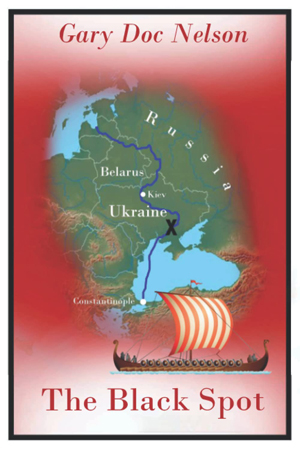
The Black Spot is the third book in the Viking Saga series. It follows the third Viking brother, Jarl Falkhand from his home in southern Sweden to the headwaters of the river Dnieper, and down to Constantinople where he captains the Varengian Guard. Two related stories are interwoven, a modern murder mystery, with the appearance of painting thought to be lost during WW II, and a third tale of the French resistance in 1942 and the rescuing of Impressionists paintings from Nazi art hunters.
The sun, nearing the end of its journey across the sky, beat down on the back of the woodcutter. The man stopped momentarily in his labor, wiping the sweat from his brow with his sleeve. The tree was cut nearly halfway through. Less than fifteen minutes more would see it on the ground.
The road next to where the woodsman was working was well traveled, mostly by German military vehicles but occasionally by the carts and trucks of the local farmers who somehow found it possible to continue with their commerce despite the Occupation. If anyone had noticed the woodsman, they would have known that something was terribly wrong with his efforts. The large notch that he had chopped into the trunk faced the road instead of paralleling it. They might also have noticed that the man’s hands were near blistered, red from his efforts with the double-bladed axe.
The man glanced at his watch, then at the rope hanging from the very top of the tree to a coil at his feet. It was almost time. Henri DeLacy took a dozen healthy swings, deepening the notch. He could feel the tree quiver now with each blow, as if looking for an excuse to succumb to the inevitable.
A man came toward him from the woods, carrying a bike across his shoulders. Like DeLacy, he was dressed in the simple clothes of a French farmer. Shorter, with a rugged, weather-worn face, he looked like he was more used to hard labor than DeLacy.
“Everything is in place. How are you coming?”
“Three more swings. I dare not risk more or the tree might fall of its own weight.” Looking at his watch again, DeLacy asked, “Have you brought the torch?”
“Yes,” said Arnaud Medau, who before the war had been in charge of DeLacy’s grounds and livestock.
“Good! Then give me a hand rigging the pulley and get to your position. We have only twenty minutes.”
Without commenting, Medau picked up the pulley and the coil of rope, and after looking carefully down the road, ran across to the woods on the other side. While DeLacy gave his last strokes to the tree, Medau climbed a large pine on the other side of the road and tied the pulley in position. Threading the end of the rope through the block and tackle, the man dropped to the ground and pulled the rope taut so that it now crossed the road
DeLacy joined him, carrying the axe and the bike. From their vantage point, they could see four hundred meters to the east. With a nod, Medau gave the rope to DeLacy and ran with an efficient rolling gate up the road in the direction they had been looking. In less than ten minutes, on top of a small hill a half kilometer in the distance, DeLacy saw a faint beam of light, indicating Medau was in position. The sun dipped beneath the tops of the trees to the west, casting long shadows on the pavement, making it difficult to see the rope. DeLacy was tempted to test the tension on the block and tackle but resisted, trusting Medau to know what was at stake passed by the spot.
Two cars and a truck filled with German soldiers pass by the spot. Dusk was deepening when DeLacy felt a cold tremor pass through his body. He heard the engine before he saw the car. As it came around the corner, DeLacy put all of his weight onto the rope. For an agonizing second he was suspended off the ground, the weight of his body having no effect on the tree across the road; then he felt his toes touch. He pulled with all his might on the rope, feeling it slacken in his hands as the tree fell with much dust and noise.
The timing could not have been better. The car, traveling at high speed had no warning. It plowed into the tree, the back wheels lifting. The two Nazi’s in the back seat were thrown out; the third and the driver remained in the car.
DeLacy ran to the side of the vehicle. Leaving his own handgun in his belt, he removed a Luger from the officer’s holster. With a quick cock of the pistol, he shot the man in the head. The second officer on the ground still, his head canted backward at ninety degrees to his shoulders. The two figures still in the car were moaning. DeLacy shot the driver, then looked down on the passenger who had been thrown sideways in the back seat, his head bleeding from a cut across the bridge of his nose. The man’s eyes fluttered, starting to open. DeLacy waited until he saw recognition in them, and then shot the man in the forehead.
DeLacy had stripped the officer in the car of his uniform and was working on one on the ground when Medau came around the bend riding another bicycle.
“Bien.” He climbed off the bike, placing it against the car. From under his short jacket, Medau took a brown canvas game bag and as DeLacy finished stripping the trousers off the last German, he filled the bag with their uniforms, identifications and Lugers.
DeLacy looked at the wreck, then at his watch, and without a word, both men climbed on their bikes and started pedaling back in the direction from which the car to a dirt road without having passed any vehicles. A mile down the tract, they came to a house with a small stable. No one was visible. They got off the bikes and went into the stable. There, already saddled, were two horses. One whinnied in greeting, recognizing Medau. The other tossed its head with a snort, as if waiting for the touch of Henri DeLacy to free him from his constraints. Hanging from the rafters were two dead pheasants. Medau tossed them in the bag on top of the German uniforms, letting the long-curved tail feathers stick out of the opening. If they were stopped, it might buy some time. Hiding the bikes in the rafters, they mounted the horses and headed west at a brisk trot.