Publisher: Waterside Productions
Series: Viking Saga
ISBN: 978-1958848722
Released: April 7, 2023


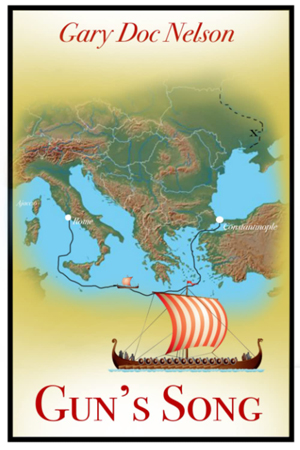
From the streets of Paris, to Constantinople in the tenth century unfold an exceptional story. In this the fourth book of the Falconi’s Gift series, Gun, the Viking Princess finds safety with villagers on the banks of the Dnieper River. Jarl Falkhand, her husband, thinks her dead and leaves Constantinople to sail home by way of the Mediterranean. However, his journey is interrupted while taking a message from the Eastern Emperor to the Roman Pope.
In the modern story, Jarl’s descendant, Mats Falconi prevents a series of terrorists’ attacks in Paris and in doing so puts his family in danger. Suzanne, his wife, knowing of her husband’s ancestor’s role serving the eastern Emperor, embarks on a quest to find the Lost Library of Constantinople.
Note from the author: This is a perfect example of an author falling in love with his characters. Gun is introduced in the Prologue of the first book in the series, FALCONI’S GIFT, where she tries to kill Jarl to protect her father. Jarl cuts off the hand holding the sword. A treaty is formed between her father and Jarl with one of the provisions that Jarl take fourteen year old Gun to his household and train her. It took until the fourth book for me to bring them together in love. Gun becomes a major character and her intelligence and strength of character drives the story.
This book also centers of a less known area of Viking expansion. From southern modern Sweden, down the Dnieper river to Constantinople. The river was controlled by a Viking tribe called the Rus from the late seven hundreds through the year one thousand. The tribe gave Russia it’s name, although Russia denies it now. It was hard to separate Jarl and Gun, but I needed to get Jarl to Corsica in order to give birth to Mats Falconi’s ancestors.
PARIS, FRANCE—2008
Mats was not sure exactly what it was about the man that caught his attention.
Perhaps it was a gesture, out of place in a diminishing line of visitors, or the fact that his neck and hands were so thin emanating from a body that was full and round under his jacket. In the end Mats decided it was the eyes, which even from the fifteen meters that separated them could be seen to be dilated to a pure black, surrounded by more white than would seem possible.
Mats’ wife, Suzanne, had sent him outside to see if the crowd had received the word that the exhibition of paintings billed as “The Recovered Treasure Trove” would not be opened to the public today, as had been incorrectly reported in the papers. The new exhibit at the Musée d’Orsay was to open in half an hour to admit only selected guests with embossed invitations.
The crowd was sparse, some still hoping that they would be the first to view the collection of fourteen Impressionist paintings that had been found in a cave in Ukraine, as well as the painting that had led to the cache—The Black Spot, a work that had placed the artist, Bretnakoff, firmly among that august company.
Mats’ wife, Suzanne, had augmented the paintings with fifteen others that had been stolen by the Nazis during the occupation and already returned to their rightful owners. She had arranged, with the help of her father for the collection to be shown first at the d’Orsay and then in a tour of four countries, concluding at the Audrey Kent Museum in Houston.
The crowd, or what was left of it, was clustered in small groups. Mats was staring blankly ahead of him when a vision flashed momentarily in front of his eyes. He saw an assassin, dressed in the black robes of a cleric. As quickly as the vision came, it was gone.
The crowd. Mats suddenly understood. The fat man with the thin neck and hands moved toward one of the remaining larger groups, hesitant, as if he had lost his purpose. Mats edged slowly toward the man, coming up to his side as he was looking at the museum’s entrance. The man’s right hand was clenched in a tight fist, his knuckles showing white. A hand on the small of the man’s back confirmed Mats’ fear. He could feel hard lumps under the fabric of the over-large jacket.
Mats grabbed the man’s fingers and, keeping them pressed against his palm, while swinging the man around. In the second that the bomber realized what was happening, before the heel of Mats’ hand struck him directly under the chin, he jerked his head to the side and looked at two men who were standing across the street. His eyes, the same ones that had made Mats notice him, now were full of a plea for forgiveness. As the man dropped to the ground, Mats followed his eyes. The two men stood, frozen for what seemed an eternity, before the taller of the two grabbed the smaller, pulling him down the Quai Anatole and out of sight.
Mats kept his hand on the bomber’s hand, afraid that there was a dead man’s switch. It took only seconds before a security officer was at his side.
“Bomb!” said Mats as the officer knelt at his side grabbing the bomber’s other hand.
In less than a minute, two more officers arrived. Mats advised them to hold the man tight, being careful to touch only skin.
No sooner was the man secured than he started to stir and awake from Mats’ blow. He began screaming in Farsi, spitting blood from a tongue that he had almost bitten in two. Two-tone horns announced the arrival of a French bomb squad, accompanied by a medic who quickly administered a shot directly to a throbbing vessel in the man’s neck. With a short spray of blood, the man lost consciousness.
“I felt something on his leg as well,” said Mats, still holding the man’s fist tight as the bomb expert unzipped the jacket.
The officer finished opening the jacket, revealing what looked like a fisherman’s vest, but instead of flies and hooks, the multiple pockets were filled with individually shaped bricks of material connected by wires leading to a switch taped to the palm of the hand that Mats clenched.
“You can let go now,” said the policeman.
The two other members of the bomb disposal unit knelt beside Mats and the first responding security guard moved next to Mats, slowly taking over, moving the arms away from the bomber’s torso and spread-eagling the man, allowing Mats to stand. The third member started to loosen the bomber’s belt buckle, but stopped at sharp command issued from the officer that had relieved Mats . The man rose and went back to the van, returning with a large pair of shears. Starting from the cuff, he split the bomber’s trousers to the belt-line on both legs, revealing a stash of explosives similar in size to the one held under the man’s jacket.
Only the French can verbally show surprise by emitting a sound like a reverse whistle. All three members of the bomb squad made the sound simultaneously as the trousers were spread apart. Rapid French went back and forth, with Mats understanding enough to realize that the explosives concealed in the pants were a new development, at least for this crew.
As Mats stared down at the prostrate form of the bomber, a policeman approached, gently pulling him away. Security guards had no trouble moving the spectators from the scene. Most had fled when they heard the words, bomb.
“Monsieur, you are to be thanked,” the medic said to Mats in French. “I am Sergeant Charmasson. I am the squad medic.” He was the only member of the bomb squad who wasn’t attending to the bomber. “If what the spectators say you did is true, you have performed a great deed, even more so because we have the bomber alive. You will wait, of course, for the inspectors who are soon arriving. They will want to question you.”
The medic had no sooner spoken these words than Suzanne, having heard the sirens and the commotion out- side the reception area of the d’Orsay, emerged, unaware of what was happening. She took in the scene, the police vehicles, the man on the ground with the explosives in full view, and ran to Mats, throwing herself into his arms.
Mats had watched her dress that morning, putting on her black ankle-length dress, paying more than usual attention to her selection of jewelry and the minimal makeup she habitually applied. He had been struck as always by her beauty, but now in the morning sun, she was more than beautiful; she was exquisite. This was to be her show, hers as the discoverer of the paintings; hers and her father’s, who had helped lead her to the discovery; hers and her grandfather’s, who had had a part in preserving the paintings during the war.
Mats preferred to stay in the background. It was not the first time. Now, he was again thrust back into the attention of the police, and of course, the Parisian press. “I’d like to make a phone call, and I would also like to get off the street, as I’m sure the press will be here soon. Suzanne, could I use one of the offices of the d’Orsay?”
“Of course,” she said, and started walking to the front of the building.
“I can’t have you leaving or using the phone until the inspectors arrive,” said the bomb squad medic.
“I’ll be in that building. You can send a man with me if you want. I won’t use the phone if you oblige me by calling Inspector Medau. Here is his number. Tell him Mats Falconi requests his assistance.” Mats gave the medic his cell phone with Medau’s number already displayed. “I’ll be inside.”